Damien Hirst is a British Artist age 52 (as of 2017) who dominated the art scene in the 1990s as part of the Young British Artists group.
He is well known as a controversial artist, not only due to the art he has created, but the sources that it came from. He is notorious for receiving accusations of having plagiarised other artists.
Hirst's interests lie in the manifestation of religion, science, life and death.
These are things that I can relate to strongly in my own practice.
Especially science, life and death.

Image by Quintin Lake of Damien Hirst
I was first inspired to look at his work because of Tyler Thrasher's work with animal skulls.

It was this piece that directly reminded me of Damien Hirst's "For The Love Of God"
"For The Love Of God" 2007

Platinum, diamonds and human teeth
6.7 x 5 x 7.5 in (171 x 127 x 190 mm)
Image: Photographed by Prudence Cuming Associates © Damien Hirst and Science Ltd. All rights reserved, DACS 2012
"For The Love Of God" is an incredible piece created by Damien Hirst, which may be one of his most influential pieces to this day.
I think that this piece has a strong impact on viewers of all age, class and occupation. The skull is something that every person can relate to, and diamonds are a material that is desirable to everyone. Hirst has transformed something morbid into something unimaginably expensive, and I can imagine that it would be quite a sight to see. Here, I can see the individual diamonds glimmering in the light. I can only imagine that in the flesh they would be blindingly brilliant.
He has completely masked death by turning a human skull (usually scary and morbid) into something desirable. Personally, the first thing I thought when I saw it is about how expensive it must have been to create, which is an example of the materialistic responses that it may provoke.
MATERIALS:
It is a platinum cast of a human skull, covered in 8,601 VVS (meaning "very very slight" aka. virtually no inclusions) and flawless pavé-set diamonds. In total, weighing 1,106.18 carats.
The teeth are REAL, and come directly from the original skull that the sculpture was cast from.
CONTEXT:
Where did the skull come from?
"The skull from which ‘For the Love of God’ was cast, was purchased from a London taxidermist and subsequently subjected to intensive bioarchaeological analysis and radiocarbon dating. This research revealed it dated from around 1720 - 1810, and was likely to be that of a 35-year-old man of European/Mediterranean ancestry" - Taken directly from http://damienhirst.com/for-the-love-of-god
What was the inspiration behind this piece?
‘For the Love of God’ acts as a reminder that our existence on earth is transient. Hirst combined the imagery of classic memento mori with inspiration drawn from Aztec skulls and the Mexican love of decoration and attitude towards death. He explains of death: “You don’t like it, so you disguise it or you decorate it to make it look like something bearable – to such an extent that it becomes something else.” - Taken directly from http://damienhirst.com/for-the-love-of-god
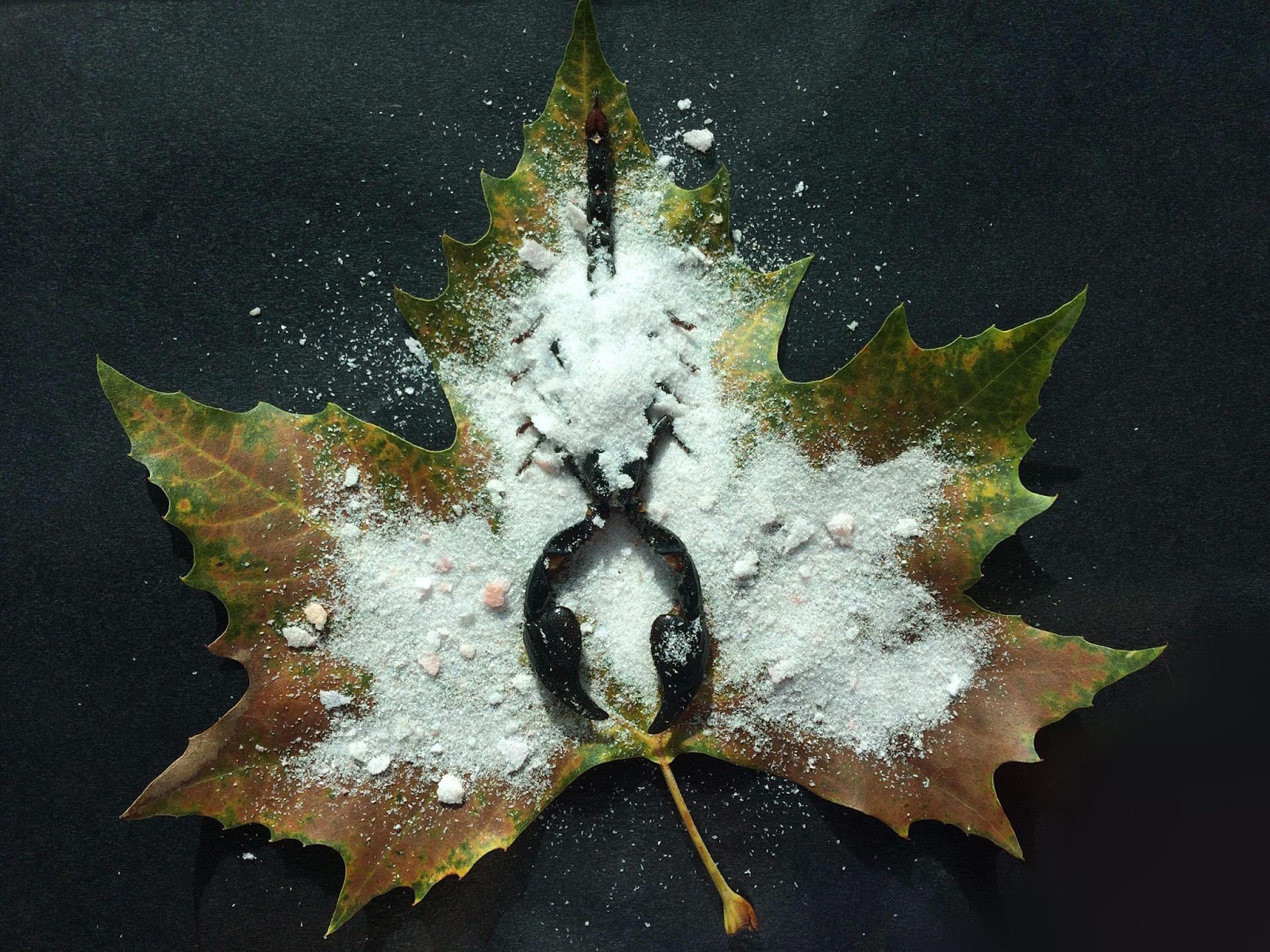
I am particularly interested in Damien Hirst's idea of romanticising death. By covering something morbid with crystals, it becomes beautiful and precious. I think that this relates directly to the work of Tyler Thrasher, and in turn, relates back to the wasp that I covered in borax crystals.

Wasps are incredibly undesirable alive, and not much better dead. But here I have definitely "decorated it to make it look like something bearable - to such an extent that it becomes something else."
I enjoy the fact that Damien Hirst has TECHNICALLY used natural materials, despite the fact that they were assembled manually. The skull that he cast in platinum was real, forming an organic and irreplaceable shape. Diamonds (although manually faceted) are from the earth, and the genuine human teeth are self explanatory. It is an interesting mix between natural substance and geometric form, which is something that I have been looking at.
When I was researching "For The Love Of God", I came across the sister piece "For Heaven's Sake". See below.
"For Heaven's Sake" 2008

85 x 85 x 100 mm | 3.4 x 3.4 x 3.9 in
Platinum, pink and white diamonds
Image: Photographed by Prudence Cuming Associates © Damien Hirst and Science Ltd. All rights reserved, DACS 2012
"For Heaven's Sake" is another piece by Damien Hirst, created in a similar process to "For The Love Of God" with similar materials - only instead of using a fully grown man's human skull, he used an infant skull. Like "For The Love Of God", it is pavé-set with over eight thousand diamonds.
See below.
MATERIALS:
" ‘For Heaven’s Sake’ is a life-size platinum cast of an infant human skull pavé-set with brilliant-cut pink and fine white diamonds. The cast is set with 8,128 perfect diamonds: 7,105 of which are natural fancy pink, while the fontanel contains 1,023 white diamonds. It was unveiled in 2010 at Gagosian Gallery Hong Kong’s inaugural exhibition, ‘Forgotten Promises’.
The skull from which the cast was taken was acquired by Hirst whilst he was working on the first diamond skull, ‘For the Love of God’ (2007). It is that of an infant estimated to be between 40 and 42 weeks of age and was purchased as part of a rare collection of 19th century human skulls and skeletons from Leiden that originated from the Delft pathology collection. "
Information taken directly from: http://www.damienhirst.com/for-heavenas-sake
Personally I find this piece to be rather scary. It has an entirely different impact to "For The Love Of God" and I think that the shape of the skull and lack of teeth are the main culprits. The shape of the skull may be perfectly organic, but it is completely unfamiliar to day-to-day viewers, as the shape of an infant's skull is very rarely seen. The lack of teeth leaves an uncomfortable, gaping hole between the jaws that looks like a crooked broken smile. The proportions of the skull are almost alien-like, and it would be easy to assume that it was an alien sculpture on first glance. The fact that it has been completely paved with diamonds removes it from childish innocence in my opinion, as it is no longer recognisable as a child's skull, it is a priceless, slightly scary artefact.
Diamond Cabinets:

Memories of/Moments with You
2008
Diptych, each: 910 x 1372 x 100 mm | 35.8 x 54 x 3.9 in
Glass, gold plated stainless steel, steel, aluminium, nickel and cubic zirconia
Image: Photographed by Prudence Cuming Associates © Damien Hirst and Science Ltd. All rights reserved, DACS 2012
http://www.damienhirst.com/memories-ofmoments-with-you

I am interested in Hirst's Diamond Cabinets due to the use of cubic zirconia (false diamonds - crystals.)
I feel that it directly relates to my work due to the generous use of crystals. Although they may not be organically grown, they are plentiful and create a scattered, overwhelming effect when viewed together. The mirror behind and below them creates a new dimension of crystals, to the point that they are almost infinite depending on the angle that they are viewed at.
I appreciate this piece of work, although, I fully acknowledge that it has greatly relied on finances. Cubic zirconia is an expensive material, as is gold plated stainless steel. I have no hope of transcribing this piece as I will never be able to afford to. Although, I do enjoy the effect of the mirrors, and how they add an entirely new dimension to the crystals that are already beautifully reflective and plentiful. Mirrors are something that I could experiment with in my own work.
I enjoy the fact that crystals are shiny and reflective, as are mirrors. I feel like it is fighting fire with fire to place crystals on mirrors, as they are both madly reflecting light in and off of eachother. It is slightly surreal and gives a sense of luxury and wealth to have a double reflection of precious belongings.
I plan to experiment with crystals in my own work due as inspired by Hirst's diamond cabinets.
-----------------------------------------------------------------------------------------------------------------


John LeKay is an English artist, based in New York. He was born in London in 1961 and is well known for his installation works. His work often includes themes of life and death, revolving around taxidermy, skulls and the human form. He is said to have been heavily inspired by the works of Francis Bacon, which inspired his "Meat Series". See below.

"This Is My Body, This Is My Blood" 1987
Although I find this piece very interesting, it is not my main focus.
I discovered John LeKay's work whilst I was exploring Damien Hirst's sculptures.
It is said that Damien Hirst has heavily copied John LeKay's sculpture work, and that he has been accused of directly plagiarising.
See below.


The plagiarism of "Spiritus Callidus" is mentioned in the book
"Intangible Natural Heritage: New Perspectives on Natural Objects"
By Eric Dorfman

Extract from
"Intangible Natural Heritage: New Perspectives on Natural Objects"
By Eric Dorfman
I am specifically interested in John LeKay's "Spiritus Callidus" series.

Spiritus Callidus #1 (Crystal Skull)
by John Lekay, 1993,
paradichlorobenzene

Spiritus Callidus #2 (Crystal Skull)
by John Lekay, 1993,
paradichlorobenzene
I think that these pieces are incredibly powerful. I do not know exactly how they were created, or what they mean, as my research of these two pieces only led me to discover the materials used, and not the process or meaning behind them.
Most of the information on the internet about these sculptures is about how Damien Hirst copied them, and not about the sculptures themselves.
It seems that John LeKay once had an official website, but it has not been working since 2013.

Wikipedia is not a reliable source, but this is the closest I found to an explanation of his inspiration:
"In 1993, inspired by Mayan skulls, he made 25 skulls, using crystal to create a glistening effect: "When the light hits it, it looks as if it is covered in diamonds."
Initially he used paradichlorobenzene, a substance more often found as a toilet deodoriser. He first showed such a skull at the Cohen Gallery. He subsequently developed this idea, using materials such as soap and wax, artificial diamonds and Swarovski crystals."
Taken directly from https://en.wikipedia.org/wiki/John_LeKay
I find it very ironic that he allegedly described his own work as "covered in diamonds" to later accuse Hirst of plagiarism with his piece.
Paradichlorobenzene is an active ingredient in mothballs.

(Image sourced from https://www.poison.org/articles/2008-oct/taking-your-woolies-out-of-mothballs )
I discovered the above image on a POISON CONTROL website, which leads me to believe that these sculptures would be harmful to create, and harmful to handle.

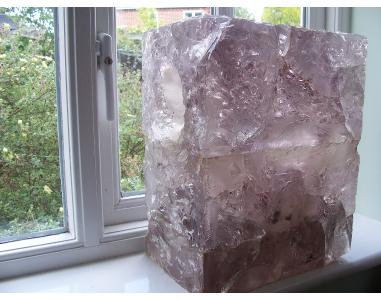
Here is an image of raw paradichlorobenzene.
(Image sourced from http://benefont.com/index.php/product-detail/moth-crystals/ )
The crystals are raw and beautiful, despite being harmful. I enjoy the idea that something so beautiful can be so toxic and dangerous. It is a sharp contrast between delicate and strong.
Harmless to look at, but dangerous to handle. A lot like my wasp, again.
Reviewing the pieces:
I think that they are much stronger pieces of work than "For The Love Of God" in terms of impact.
These skulls may not be organic (they seem to have been carved) and they may not be expensive, but they are haunting. They look like they have decayed, but the eye holes seem too circular to be realistic, which is disconcerting.
The lack of teeth is haunting, much like Damien Hirst's "For Heaven's Sake".
I am drawn to the natural forms in this piece, alongside the natural materials. I think that the organic formations hold much more meaning and personality than stiffly, manually placed diamonds.
Whilst researching John LeKay, I came across this image many times.

Bloggers were claiming that it belonged to John LeKay.

This didn't seem right, so I researched it further to discover that it belongs to Vladimir Anselm.


Vladimir Anzelm. "Stone flower", bituminous coal, resin, 2007

Vladimir Anselm, boy Sculpture in coal with object in pyrite, 2013.


Vladimir Anselm,"Walter" Sculpture in coal.


"Lion Skull" in coal
Vladimir Anselm is an artist originally born in Germany, who now resides in Russia. His work has been displayed in galleries across Russia, including Moscow.
He works with natural stone such as coal and pyrite. They are rough, natural formations which he places manually to create sculptures with recognisable shapes, but also with heavy, organic textures.
He seals each piece individually with clear, shiny lacquer. He uses a different technique each time, as the application of the lacquer can make a piece look entirely different.
"At the final stage of the sculpture-making, I put a shiny layer on the top of the coal. This is the most important step because you need to catch the right rhythm and to understand the structure and texture of the sculptures very well. Depending on how you put the final coating layer, the sculpture can look very impressionist or baroque or classic. So the coal and my working process allow me the freedom and possibility to create diversity."
Taken directly from http://www.initiartmagazine.com/interview.php
It was very difficult to pin him down as most of his information was in foreign languages, but I was lucky enough to find a full interview on one of his exhibitions in Moscow.
(http://www.initiartmagazine.com/interview.php)
I was interested in his decision to use coal in his work, as it is such an abstract material. It is viewed as dirty and worthless, but he has turned it into many beautiful things.
The interview answered my question.
ST : Why did you choose to work with anthracite coal?
VA : Coal evokes many layers of meanings and associations. It represents something deep inside. It comes in stratum which reminds us of the history of the earth and the hierarchy in the society. Coal is often associated with the subconscious because it’s a compressed form of mineral. As a material, it’s created through the process of fossilization which compresses something organic into non-organic. Though coal and diamond share the same structure, one is perceived as basic, the other as noble. Such difference is similar to that of low and high cultures. When coal is compressed under high pressure, it becomes diamond. In our association of coal with the subconscious, compression becomes crystallization and you would find the diamond inside of you. The shiny diamond for me is the access to the soul, the spirituality, the truth.
Taken directly from http://www.initiartmagazine.com/interview.php
I find it beautiful that Anselm is able to relate coal to diamond, both scientifically, metaphorically and artistically. I feel like Anselm's rendition of a skull is the polar opposite of Hirst's "For The Love Of God" visually, and in how they are valued - but ultimately, they are two sides of the same coin.


I will be taking inspiration from all three of these artists to form a response.