This is a Deaths Head Moth.
He or she was ethically sourced from a friend of mine who hand raised him or her.
I chose this moth specifically due to the dark connotations that follow it. The markings on the back of its "head" are supposed to resemble a skull, thus the name.
They are symbolic of death and widely feared among the superstitious. Their modern fame came from the movie "The Silence of the Lambs" which is an incredibly sinister film in itself.
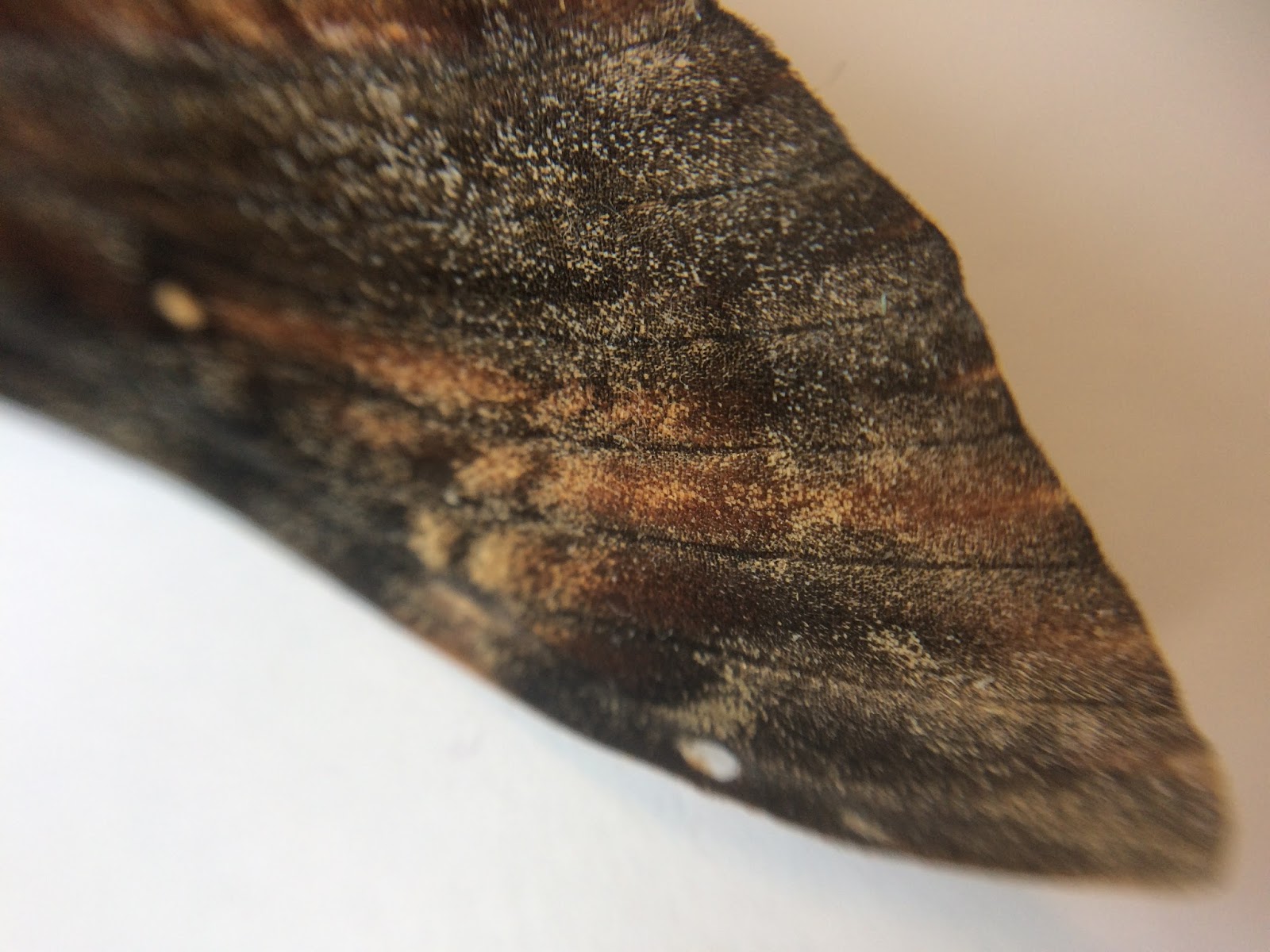
I used a macro lens to capture the significant features of the moth.
I found it shocking just how soft and fluffy the moth's body was.
Even the "skull" marking was soft to the touch.
It was anything but scary.
The markings of the wings were subtle. Hard to see from far away, yet interesting up close.
The underside of the wings were just as prominently marked.
I decided that I wanted to return to the use of foil, to explore whether I could recreate the effect of my iridescent butterfly wing
on a larger scale.
But instead of using the top side of the wings, I wanted to work with foils BENEATH the moth's wings.
I enjoyed the idea of the iridescence being hidden and then discovered by the viewer, to create an ultimately personal, small scale and intimate experience.
I measured the size of the wings as closely as I could, and used nail polish to affix the foils directly to the wings.
It was a nightmare.
For some reason, the foil began to react negatively. It was originally a solid gold foil with no pattern, but as I affixed it to the wing, it began to break and turn silver in strange places.
I gave it a chance, as I was unsure whether I liked the effect or not.
Close up imagery showed the iridescence, but also the poor placement of the foil. It looked childish and ill fitted.
Part of me enjoyed the effect. I thought that perhaps it could have been successful if it was not foil, and perhaps gold leaf or smooth paint. But the foil was not reacting well to the moth's wing at all, and looked cheap, broken and ineffective.
Although, when the wasp was turned over, the foils were completely hidden as I had originally planned. I achieved the goal of creating a "hidden" effect, at the very least.
Final photograph of the "golden" moth.
Before the "golden" wings fell straight off. I was more relieved than annoyed.
I thought that I would return to my use of crystals, but in a new way.
Below is the moth in the borax solution, although instead of being entirely submerged beneath the water, the "body" of the moth was half concealed and half dry.
2 days later.
Not much had really happened. I did not use enough borax.
Although, it was interesting to see the effect of very minimal crystals amongst the natural patterns of the wings.
The less crystals there are, the easier it is for the viewer acknowledge the individual geometric shapes of each individual crystal.
I retried the same experiment using MUCH more borax.
In fact, I added more borax than I knew I needed. I tripled/quadrupled the dosage.
I used a small sewing pin weighted with a button to keep the moth secure where I wanted it. Half submerged, half dry.
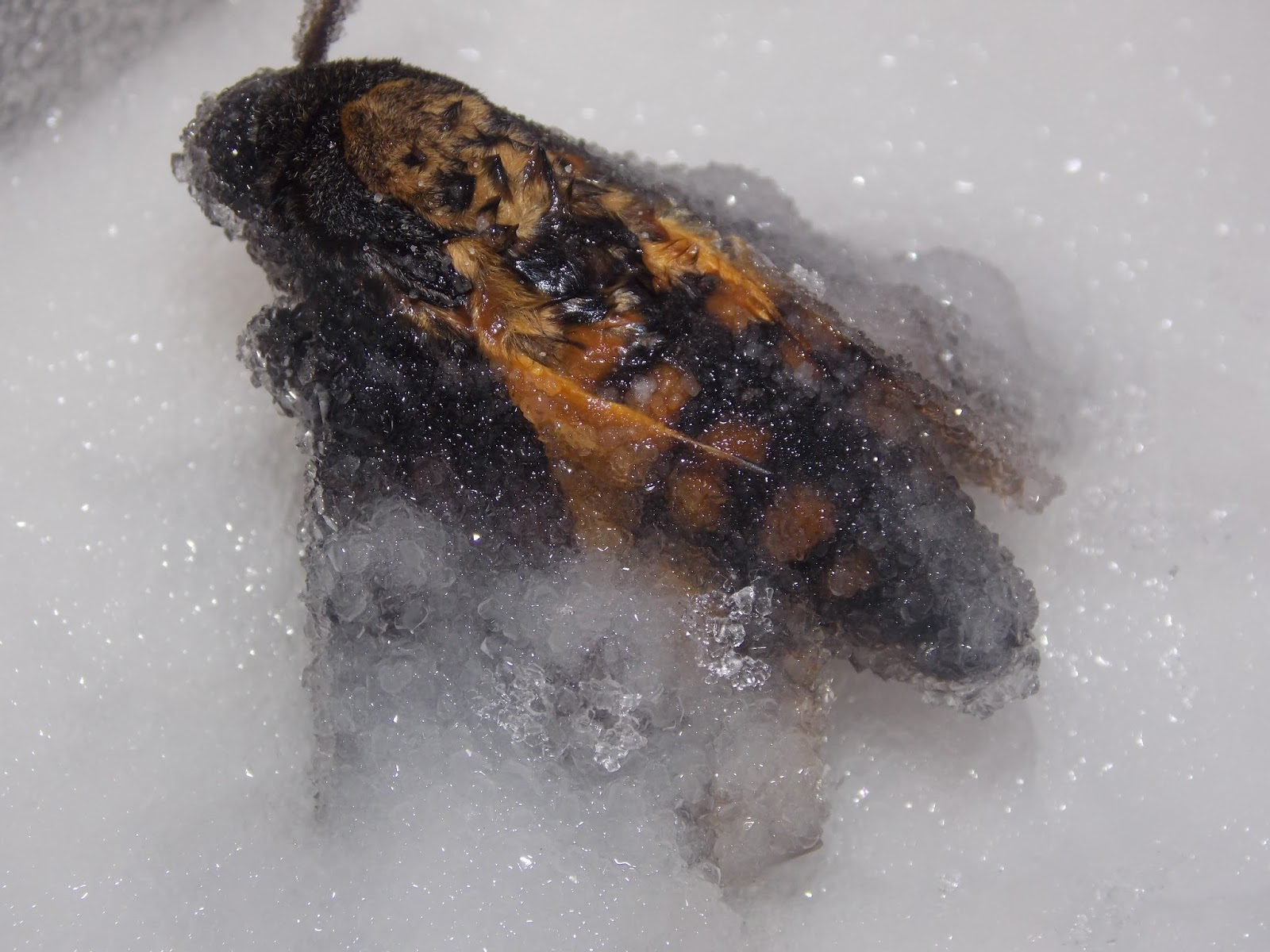
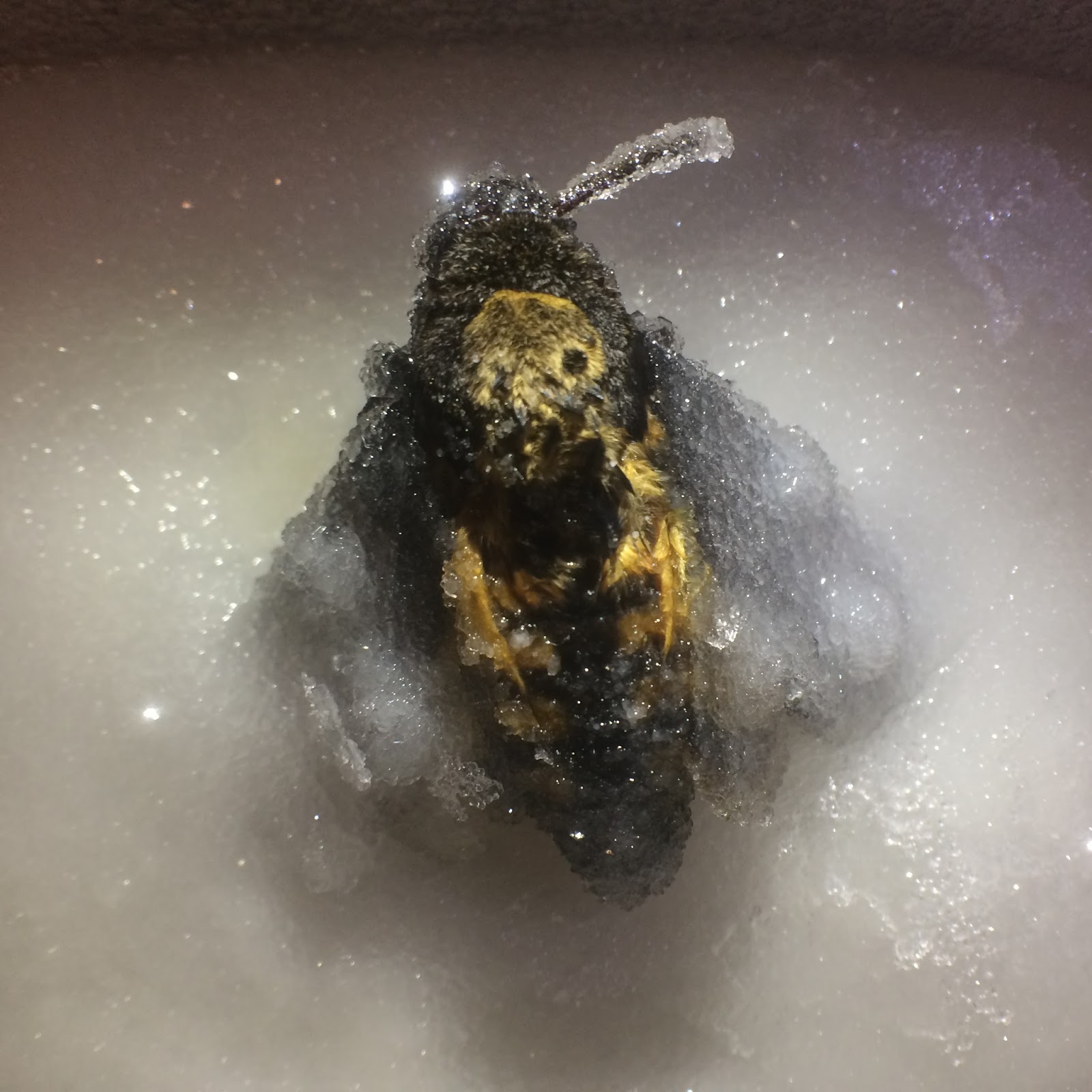
The result was powerful.
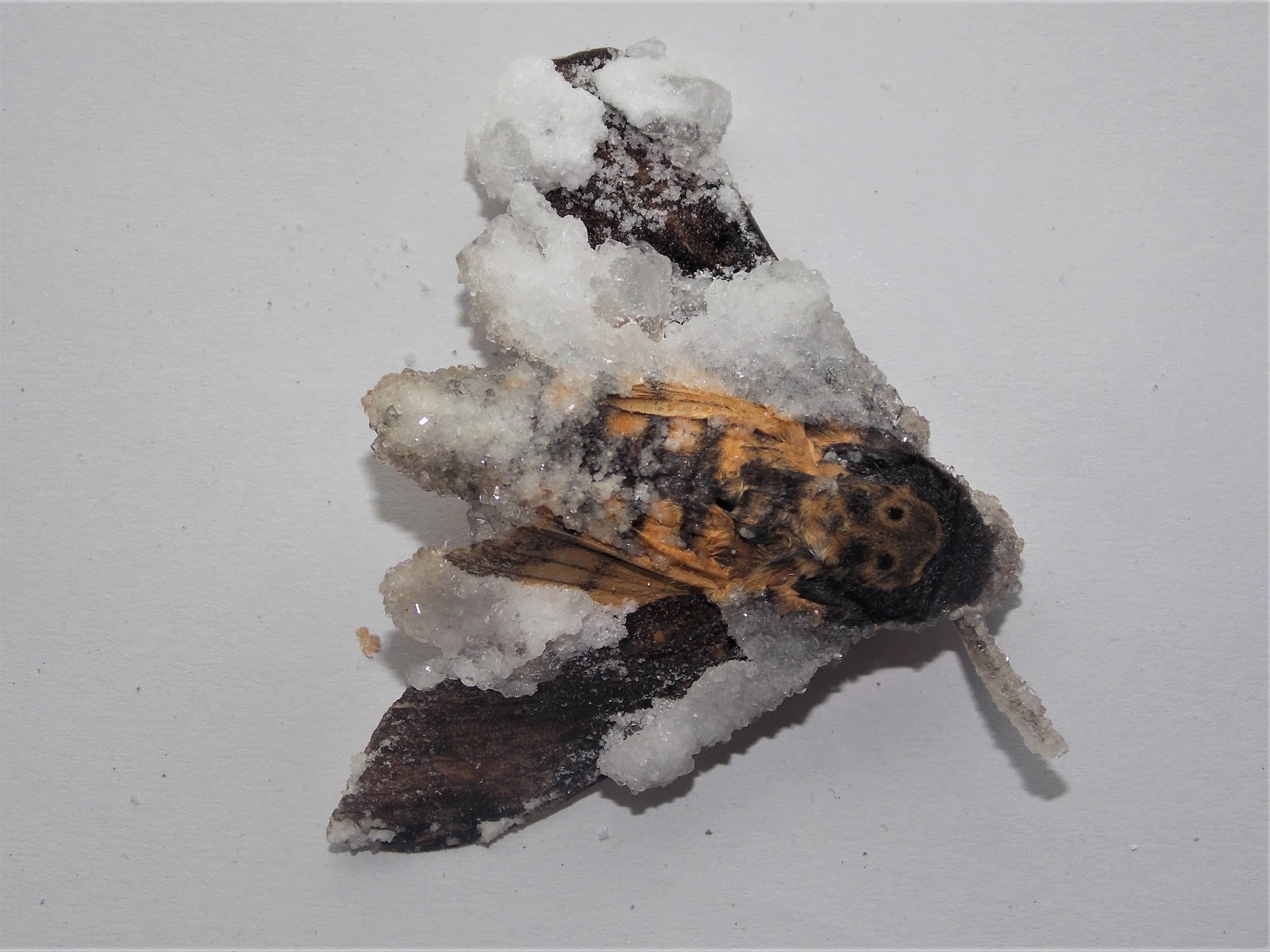
The entire of the container was occupied with solid crystals.
I used the torch of my phone to properly illuminate the crystals, to show the full effect.
I removed the pin, because the crystals were now strong enough to hold the moth in place by themselves.
The effect was interesting. Close up, it is difficult to tell what is going on. The creature's wings are completely trapped, and viewers cannot tell whether the moth is alive or not. This could be unsettling.
On the other hand, the crystals surrounding the moth are beautifully glistening like snow or ice. This could be soothing and intriguing.
There is a stark contrast.
Not to mention, the skull of the moth is very vividly on show. The colours of the moth create a strong juxtaposition against the colourless crystals.
I especially love how the delicate antennae of the moth has also gathered crystals. It is incredibly fragile, as are the crystals.
Experimenting with different lighting.
I enjoyed experimenting with photographing this piece.
The piece itself is small and heavily dependent on lighting, whereas my photographs have captured every small detail of the piece in many different ways. Each photograph evokes a different response, and most of the photographs hold some ambiguity to them that provokes the viewer to ask a question as response.
Displaying the piece in this way would have been problematic for several reasons.
1. The plastic tub was not intended to be part of the sculpture.
2. The crystals are incredibly delicate and would easily break if attempted to remove from the tub.
3. The moth itself is very small, and the important details would go unseen by the naked eye.
I love how the moth's strong connotations of death are still present in these images. The skull is on show, but the rest of the moth is being overtaken by crystals, which gives an interesting hierarchy.
The delicate, fragile white crystals are restraining death itself, as a metaphor.
Although, I knew that the small plastic tub could not be displayed as a sculpture, so I gently pulled the moth out of the crystal base. The results were shocking.
Here is the moth having been freshly removed from the tub.
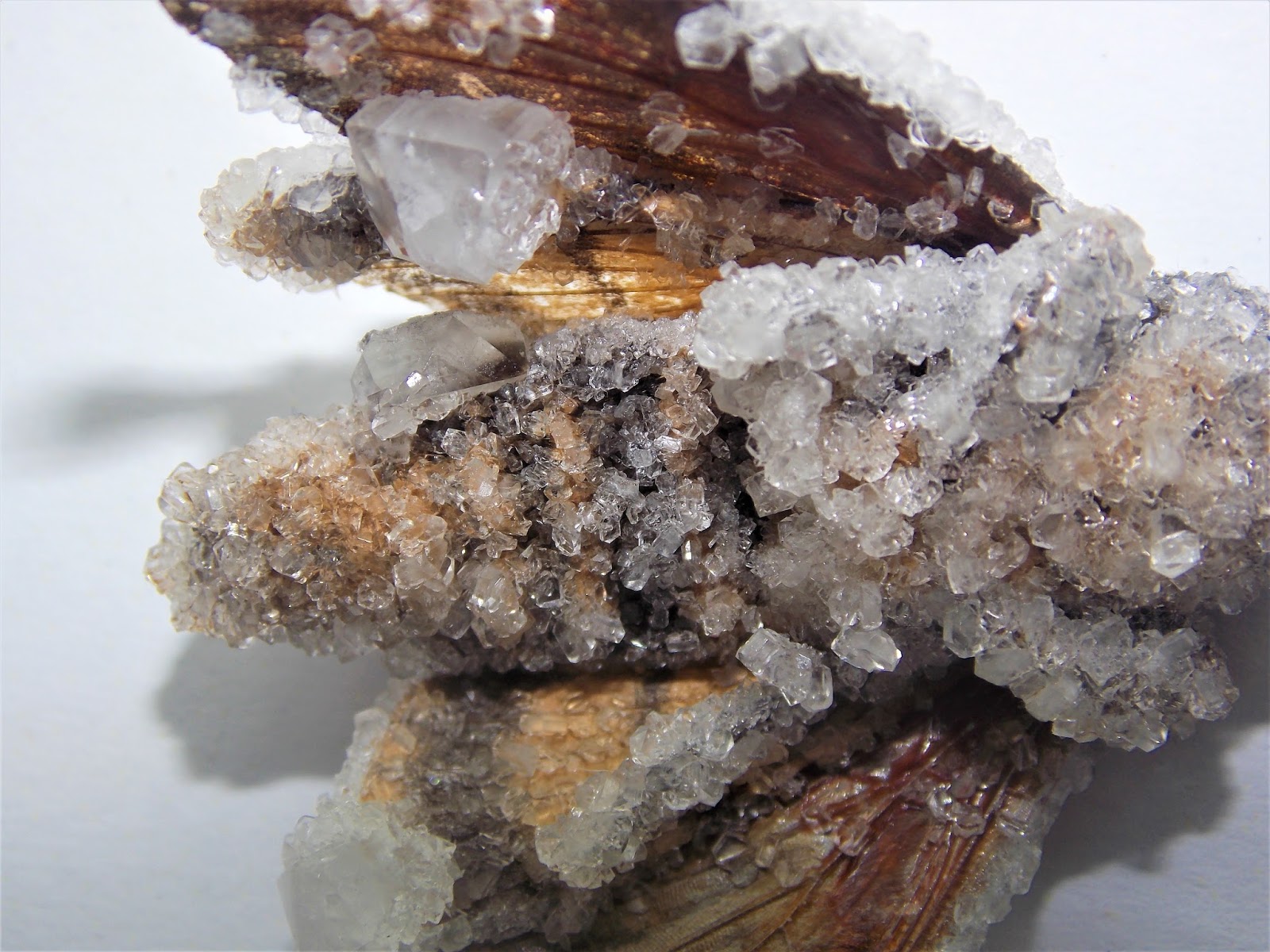
The nail polish on the bottom of the wings had prevented the crystals from clinging to them too much. But the bottom of the moth was completely encased in tiny, delicate crystals.
Like a crystal cocoon.
I did not expect this to have happened beneath the moth. Instead, I expected there to be some mild damage to the bottom of the moth following being pulled out of a crystal prison.
The effects were beyond what I could have asked to happen. I was thrilled with every single crystal, and where it was.
The transparency of the crystals on the body of the moth is just enough to allow the viewer to determine the markings beneath them.
The back of the crystal was not quite so pretty. The crystals had broken into jagged patterns when being removed from the original tub.
Although, it made the moth look rather pitiful, which I think is an interesting reaction to have to a notoriously sinister moth.
I experimented with placing it atop and amongst naturally grown crystals.
I chose this piece of lepidolite due to its natural iridescence, and due to the fact that the warm purple hues compliment the gentle orange tones of the moth's wings. It creates a warm image with more variations of colour (whilst remaining natural).
This crystal is a long, white piece of selenite. It is a natural stone, but due to its semi-transparent white nature, it compliments the crystals surrounding the moth.
Above is an image of the moth having been placed back into the tub that it originated from. The crystal surface had cracked and created an interesting series of patterns.
Before
After
I decided to play amongst the metaphors that made the Deaths Head Moth famous.
I placed the moth atop the crystal skull I created previously as a response to Damien Hirst/John LeKay.
This was an attempt to mimic the "Silence of the Lambs" poster that made the Deaths Head moth as infamous as it is today.
The original poster (no copyright intended - belonging solely to the creators of Orion Pictures).
An closer look at the original poster as explored by http://posterwire.com/silence-of-the-lambs/
Under close inspection, the skull of the death's head moth is not a genuine marking. It is substituted for a reproduction of Salvador Dali's famous portrait “In Voluptas Mors”(“Voluptuous/Desirable Death”).
I see my photograph as a development of the original poster, taking the use of the skull and advancing it further.
I am immensely pleased with this image. The moth seems to blend into the skull behind it due to the fact that the crystals are one and the same. It is seamless and beautiful in my opinion. Although, there is great ambiguity, and the image leaves many questions. The skull is not an easily recognisable skull, and the moth is no longer recognisable as a deaths head skull.
I don't think that if an anonymous, random viewer saw this piece, that they would associate it with the silence of the lambs.
I experimented with the hue of the overall image, simply to add to the surrealism of the piece.
Overall, I am pleased with how my moth has developed through an accident in order to create a piece better than I could have originally anticipated. If I had not attempted to foil the wings in the first place, the wings would not have become coated in nail polish, and the effect of the crystals may have been much different as the wings would have been much more fibrous.